

Please select your location and preferred language where available.
UFS 4.1/3.1 – The Right Choice for Today’s Performance Needs
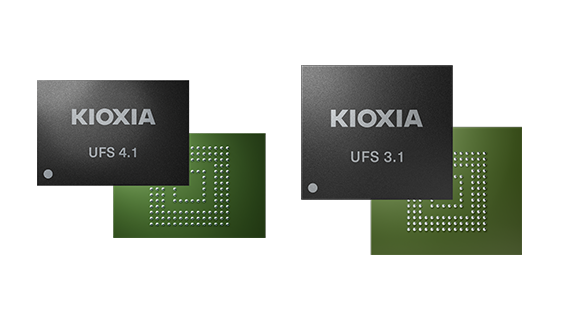
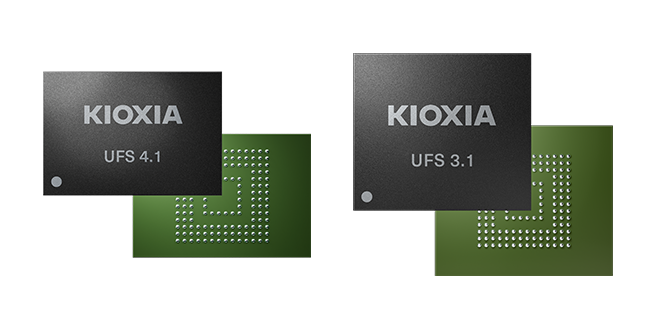
Designed to be the embedded storage of choice for mobile applications, KIOXIA Universal Flash Storage (UFS) delivers breakthrough read/write speeds, low power consumption and quick application launch times demanded by a wide range of digital products.
KIOXIA UFS 4.1/3.1 solutions are compliant with JEDEC®, and integrate the company’s BiCS FLASH™ 3D flash memory with a controller in a JEDEC-standard package.
Ushering in a new era of embedded storage technology, KIOXIA UFS delivers an innovation leap over previous managed flash technology standards for applications needing faster speeds and greater efficiency.


KIOXIA UFS 4.1 Features & Benefits
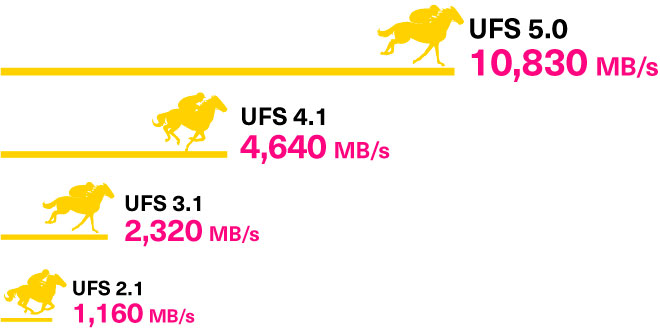
UFS 4.1 offers lightning fast embedded storage transfer speeds allowing next-generation smartphones and mobile applications to take advantage of 5G mobile networks and AI. UFS 4.1 incorporates MIPI® M-PHY® 5.0 High-Speed Gear 5 and UniPro® version 2.0, and supports theoretical interface speeds of up to 23.2Gbps per lane or 46.4Gbps(1) per device. UFS 4.1 is backward compatible with UFS 3.1 so existing platforms can use the latest generation of Flash Memory technology used in UFS 4.1, while incorporating all of the existing UFS 3.1 features.

Key Features
- Fast serial interface speed
- High performance for reads and writes
- Optimal power efficiency
- Support for full duplexing
- Low pin count
- 9x13mm BGA packages
- JEDEC standard
- 256GB, 512GB, 1TB(2)
Faster Performance(3)
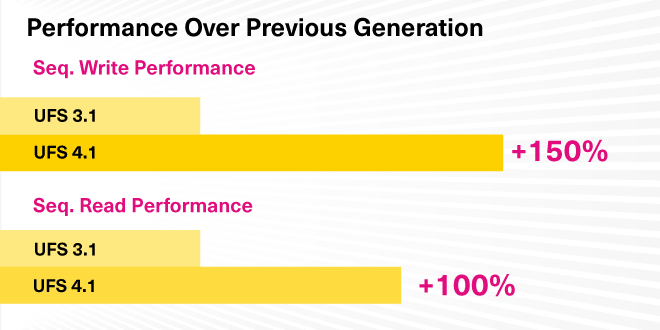
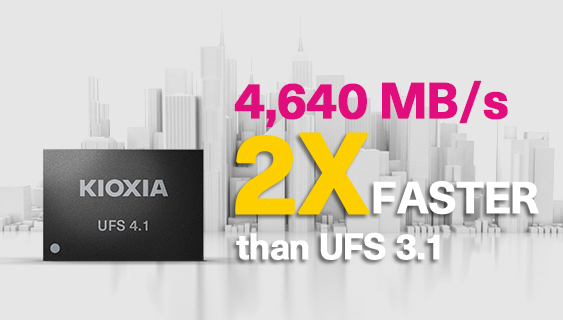
Sequential read and write performance of UFS 4.1 devices has improved by approximately 100 and 150 percent respectively, over UFS 3.1 devices.* WriteBooster technology is incorporated to boost sequential write speeds for faster downloads, make high definition video recording storage quicker, and speed up mobile gaming.
* Kioxia Corporation’s UFS3.1 512GB device “THGJFGT2T85BAIU”
Small Package Size
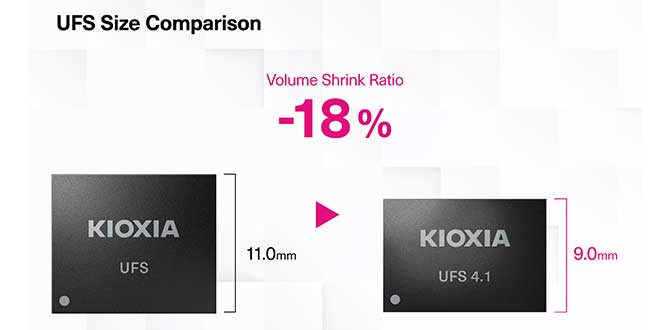
The UFS 4.1 supports a smaller 9mm x 13mm package, an 18% reduction in size compared to UFS 3.1 for additional space savings in mobile applications, making handsets even smaller and sleeker.
KIOXIA UFS 3.1 Features
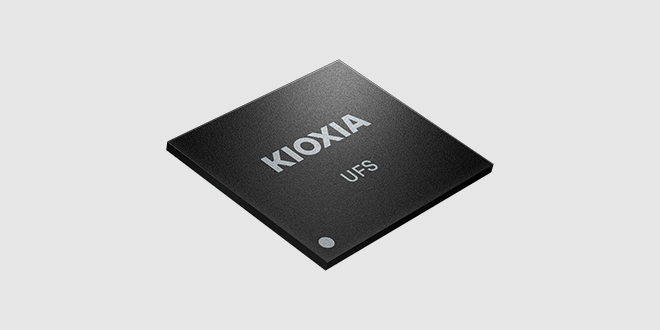
- Serial Interface
- High Speed Reads/Writes
- Low pin count
- 128GB, 256GB, 512GB(2)
- 11 x 13mm 153ball BGA package
- JEDEC Standard
UFS 4.1 vs UFS 3.1
KIOXIA offers UFS 5.0, UFS 4.1 and UFS 3.1, a family of high-capacity flash memories with an integrated controller. These flash memory solutions provide ECC and other control functions that are optimized for each flash memory technology generation. UFS reduces the workload on the host processor, simplifies product development, shortens time-to-market and increases ease of use in memory products.
Compared to UFS 3.1, UFS 4.1 delivers:
- A faster interface
- Higher performance for reads and writes
Why KIOXIA UFS

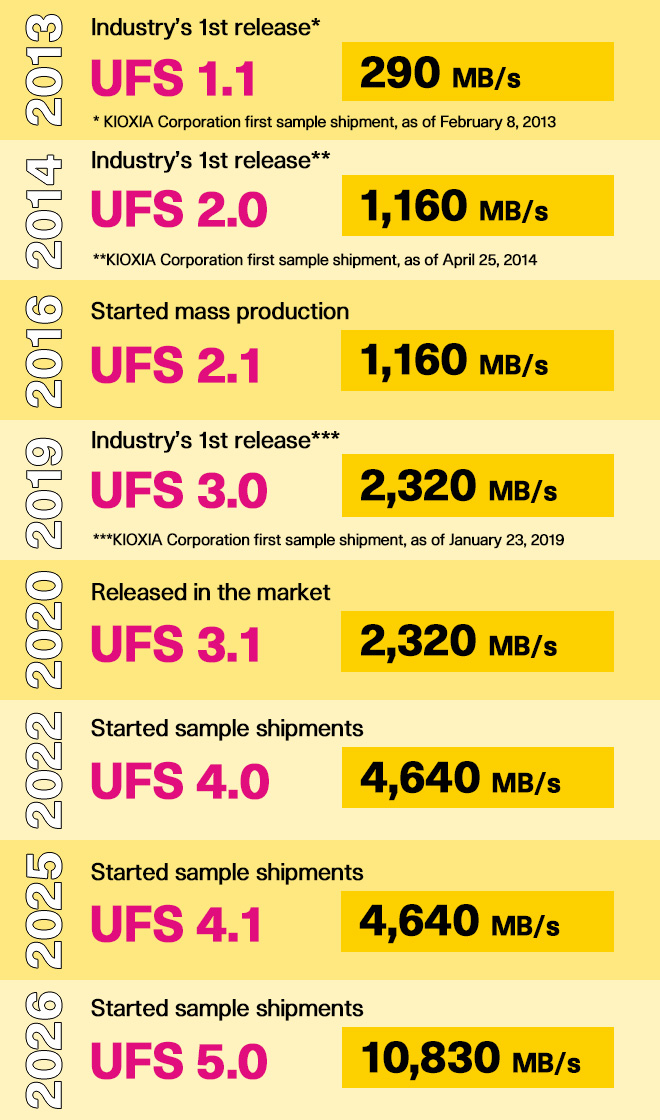
KIOXIA continues its legacy of innovation with the introduction its UFS 5.0 flash memory solutions, addressing the need for ever-increasing speed and efficiency in modern embedded storage. Building on years of technological leadership and a track record of industry firsts, KIOXIA UFS 5.0 solutions are engineered for demanding applications, like on-device AI in smartphones and other high-performance computing systems.
KIOXIA's Latest Generation UFS 5.0
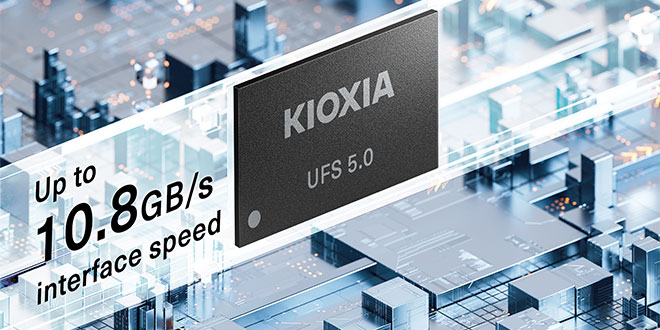
UFS 5.0 takes embedded storage technology to the next level, delivering even faster transfer speeds and improved power efficiency for future smartphones, tablets, and AI-powered mobile devices. Building upon the advancements of its predecessors, UFS 5.0 utilizes MIPI M-PHY version 6.0 High Speed Gear6 and UniPro version 3.0, supporting theoretical interface speeds of up to 10.8GB/s(1) (10,830 MB/s) per device. UFS 5.0 maintains backward compatibility with UFS 4.1, ensuring seamless integration with existing platforms while delivering enhanced performance and support for the latest flash memory innovations.
KIOXIA UFS 4.1/3.1 Key Technology

WriteBooster Functionality
WriteBooster enhances write performance by utilizing the existing user data area as a temporary SLC buffer without sacrificing capacity. Maximum SLC buffer size can be configured by the host at device configuration and the host can keep writing data to the buffer until the buffer is filled. This feature is enabled dynamically during operation by the host depending on system performance requiriements of 5G and other applications.
High Speed Link Startup Sequence (HS-LSS) support**
With conventional UFS, Link Startup (M-PHY and UniPro initialization sequence) between device and host is performed at low-speed PWM-G1 (3~9Mbps)***, but with HS-LSS, it can be performed at faster HS-G1 Rate A (1248Mbps). This is expected to reduce the time for Link Startup by approximately 70% compared to the conventional method.
** Key technology of UFS4.1 only
*** PWM-G1 communication speed depends on the product.

Advanced Technology
KIOXIA UFS utilizes high-performance BiCS FLASH™ 3D flash memory technology to optimize performance.
KIOXIA UFS 4.1/3.1 Key Applications

Notebook / Ultrabook™ / Tablet / Desktop PC / Gaming PC

Smartphone / Smartwatch / Smart glasses

Game console / Smart TV / Virtual Reality Headsets / Set-Top-Box/Digital Video Recorder / Smart speaker / Smart home / Wearables / Home Health / Home Network
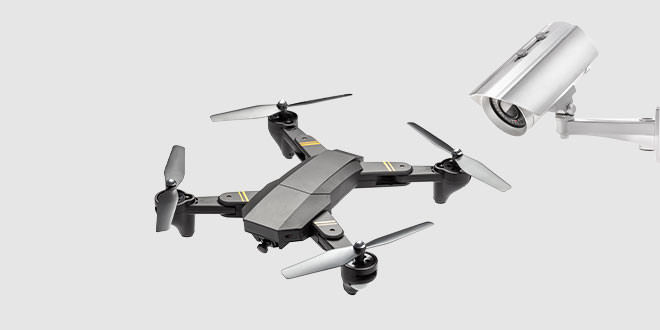
Automation / Digital Healthcare / Transportation / Surveillance / Robot / Drone / Security / Digital Signage / Networking (5G area network) / PoS (Point of Sales)
Learn and Evaluate
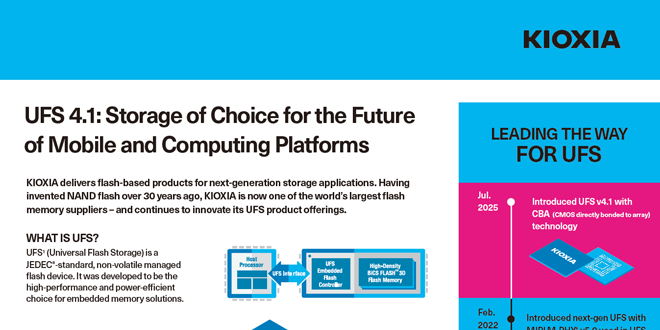

UFS 4.1/3.1 Specs
UFS 4.1
*Table can be scrolled horizontally.
| Capacity(2) | Part Number | UFS Version |
Max Data Rate (MB/s) |
Supply Voltage | Operating Temperature (℃) |
Package Size (mm) |
||
|---|---|---|---|---|---|---|---|---|
| VCC (V) |
VCCQ (V) |
VCCQ2 (V) |
||||||
| 256GB | THGJFRT1E45BATV | 4.1 | 4640 | 2.4 to 2.7 | 1.14 to 1.26 | - (4) | -25 to 85 | 9.0x13.0x0.8 |
| 512GB | THGJFRT2E48BATV | 9.0x13.0x0.8 | ||||||
| 1TB | THGJFRT3E88BATW | 9.0x13.0x0.85 | ||||||
UFS 3.1
*Table can be scrolled horizontally.
| Capacity(2) | Part Number | UFS Version |
Max Data Rate (MB/s) |
Supply Voltage | Operating Temperature (℃) |
Package Size (mm) |
||
|---|---|---|---|---|---|---|---|---|
| VCC (V) |
VCCQ (V) |
VCCQ2 (V) |
||||||
| 128GB | THGJFPT0E18BAIP | 3.1 | 2320 | 2.4 to 2.7, 2.7 to 3.6 |
1.14 to 1.26 | - (4) | -25 to 85 | 11.0x13.0x0.8 |
| 256GB | THGJFPT1E28BAIP | |||||||
| 512GB | THGJFPT2E48BAIP | |||||||
- The definition of 1 Gbps is calculated as 1,000,000,000 bits/s. The definition of 1 GB/s is calculated as 1,000,000,000 bytes/s, and 1MB/s is calculated as 1,000,000 bytes/s. This is a theoretical value calculated from the interface speed and the speed of a user’s device is not guaranteed. The read/write speed may vary depending on the host system, read/write conditions, file size, etc.
- Product density is identified based on the density of memory chip(s) within the Product, not the amount of memory capacity available for data storage by the end user. Consumer-usable capacity will be less due to overhead data areas, formatting, bad blocks, and other constraints, and may also vary based on the host device and application. For details, please refer to applicable product specifications. The definition of 1KB = 2^10 bytes = 1,024 bytes. The definition of 1Gb = 2^30 bits = 1,073,741,824 bits. The definition of 1GB = 2^30 bytes = 1,073,741,824 bytes. 1Tb = 2^40 bits = 1,099,511,627,776 bits.
- Performance figures are based on internal tests. Actual results may vary depending on host device, usage patterns, and other conditions.
- This product supports dual-supply operation at VCC and VCCQ. VCCQ2 is not necessary.
- JEDEC is a registered trademark of JEDEC Solid State Technology Association
- MIPI®, M-PHY® and UniPro® are registered trademarks owned by MIPI Alliance.
- Ultrabook is trademark of Intel Corporation or its subsidiaries.
Support

Please contact us if you have any technical questions, requests for materials, are interested in samples or purchases of business products (Memory, SSD), etc.
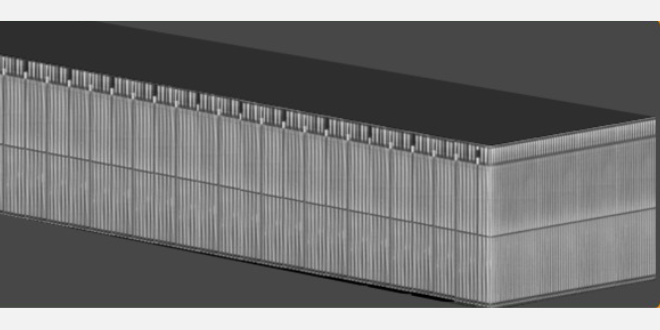
In 2007, KIOXIA announced the world‘s first 3D flash memory technology. Presenting our cutting-edge technologies, along with the key points of innovation and our efforts toward further increases in capacity.
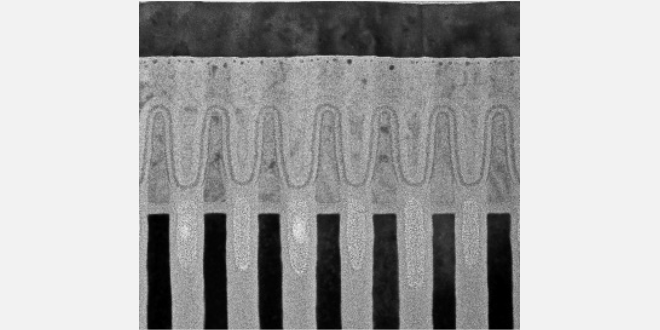
KIOXIA invented the world’s first NAND flash memory in 1987. This is an explanation of the structure of flash memory and the mechanism of data storage.
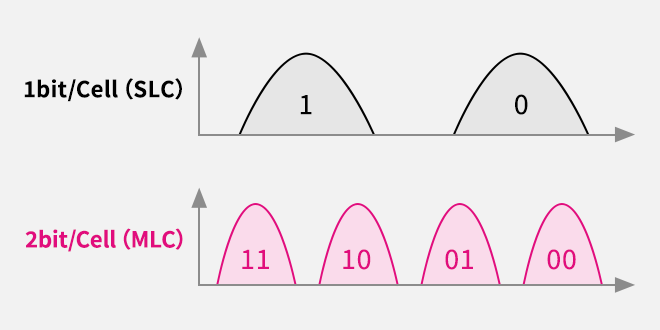
“Multi-level cell technology” is one of the main technologies realizing larger capacity flash memory. The 1 Gbit MLC NAND flash memory launched by KIOXIA in 2001 was the first application in the world of multi-level cell technology to a NAND flash memory product.


