

Please select your location and preferred language where available.
Multi-level In-Memory Computing with 3D Flash Memory using Activation-Time-Modulated Sequential Multi-Block Access and Tightly Integrated Current Control Cell (CC cell)
September 28, 2026
Energy consumption by high-performance computing is enormous as AI and machine learning become more widespread. There is a strong demand for technology that improves both computing performance and energy efficiency. One solution is “in-memory computing,” which reduces energy consumption associated with data transfers between processor and memory by providing computing functions in memory.
In our previous work, we developed energy-efficient in-memory computing technology using 3D flash memory. We showed that it is possible to perform 1-bit and 128-dimensional approximate search without any additional circuit for word line control. It also does not require large storage capacity for storing key data of 1 bit depth in 3D flash memory[1]. Recently, more computational models using binary or lower bit depths have been developed for edge computing. However, using data with multiple bit depths is still advantageous for higher accuracy[2].
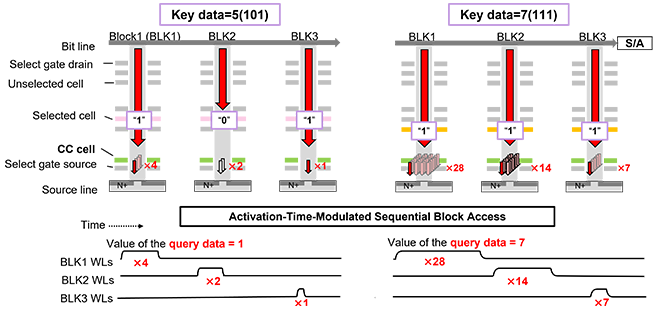
In this work, we proposed a novel approximate search method of activation-time-modulated sequential multi-block access for multi-level in-memory computing (Figure 1). Approximate search is a process of searching for vectors similar to the query data in a set of vectors (key data).
Key data is stored in weighted value of binary digits along the bit lines. The query data is applied to the selected word line as activation time. The word line activation time is determined by the bit depth of the key data and the value of the query data. A current control cell (CC cell) is placed for each string, and its role is to limit the current of the on-string to a constant lower value. The on-current of each bit line is determined by the CC cell. The inner product of vectors which is obtained from the sum of the on-currents indicates the similarity between the key and query vector data.
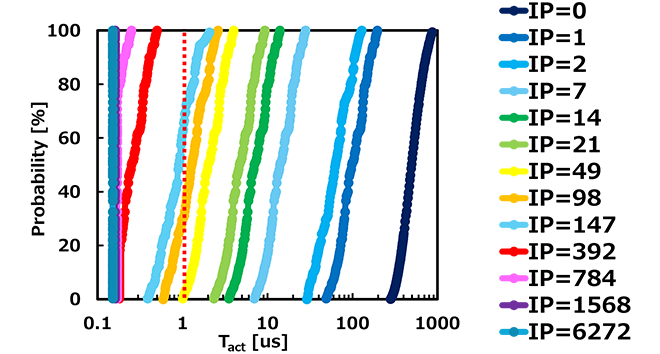
Approximate search was evaluated using 3-bit and 128-dimensional vector data. As shown in Figure 2, it is possible to select an inner product less than or equal to 49 with a probability of more than 99 percent. The target inner product is controlled by the selected word-line voltage of the CC cell, and the unit activation time of the word line, Tact.
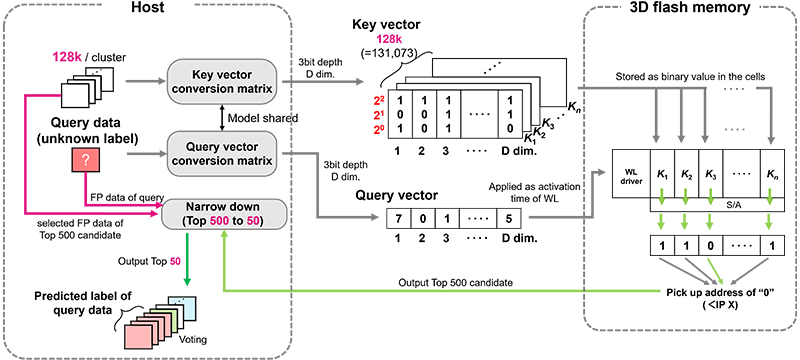
The procedure for approximate search using in-memory computing is shown in Figure 3. In approximate search, the label of query data, such as an image or text given by the user, is estimated. In the 3D flash memory, key data converted from a pre-known dataset into multi-level vectors are stored as knowledge along each bit line. The query data are also converted into multi-level vectors using the same conversion matrix as that used for the key data. For the query data, the inner products with the key data are calculated, and the candidates of key data with high similarity are extracted. Since the 3D flash memory has a large number of bit lines, this calculation can be performed in parallel. Finally, on the host side, the most similar data are determined from the extracted candidates, and the label of the query data is estimated with high accuracy by majority voting. Since the candidates for this host-side calculation are sufficiently narrowed down by the results of the 3-bit and 128-dimensional vector inner products, both low power consumption and high accuracy can be achieved.
This achievement was presented at the IMW 2026.
Reference
[1] Kana Kudo et al., “Energy-Efficient In-Memory Computing using 3D Flash Memory with Sequential Multi-Block Activation and Current Control Cell (CC cell)”, IEEE International Memory Workshop (IMW), 2025, pp. 1-4.
[2] Y. H. Lin et al., “NOR Flash-based Multilevel In-Memory-Searching Architecture for Approximate Computing”, IEEE International Memory Workshop (IMW), 2022, pp. 1-4.
[3] Kana Kudo et al., “Multi-level In-Memory Computing with 3D Flash Memory using Activation-Time-Modulated Sequential Multi-Block Access and Tightly Integrated Current Control Cell (CC cell)”, IEEE International Memory Workshop (IMW), 2026.

A technical glossary that covers terms related to KIOXIA products and technologies, such as memory and SSDs. We explain that it can be used by engineers and researchers to the general public.

KIOXIA has established industry-leading R&D frameworks with “memory” technology. We use our various locations to conduct technological innovation while promoting open innovation.


