

Please select your location and preferred language where available.
Toward Achieving Net-Zero Greenhouse Gas Emissions


July 1, 2026
The Kioxia Group aims to achieve net-zero greenhouse gas emissions by FY2050. Here are our long-term strategy and the specific initiatives to achieve it.
Long-term strategy toward net-zero
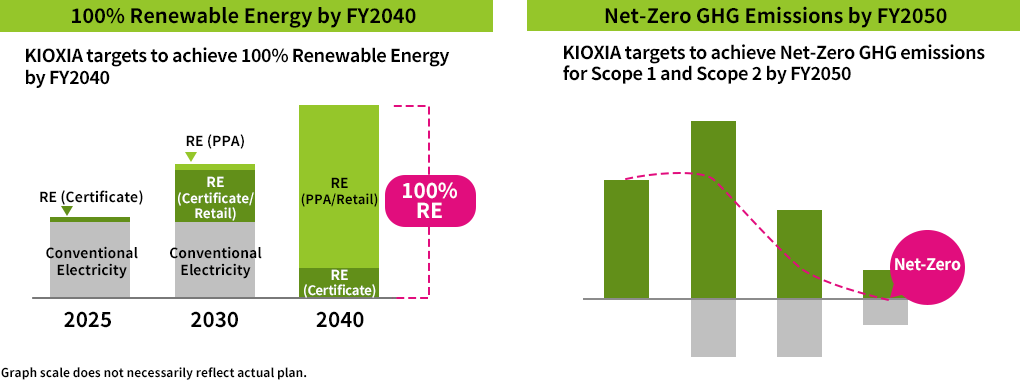
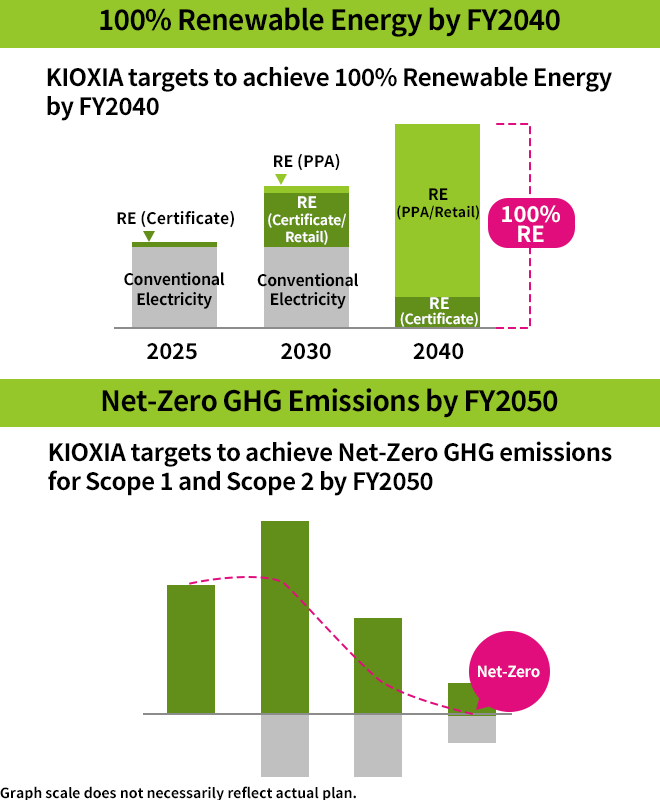
With the aim of contributing to the achievement of the goals of the Paris Agreement, the Kioxia Group has set a target of net zero greenhouse gas emissions from its business activities by FY2050. In addition, we aim to use 100% renewable energy by FY2040.
Obtained SBTi approval for near-term targets
As part of our long-term strategy, we obtained approval from the SBTi*1 for our greenhouse gas reduction targets in May of this year which are the core of our medium- to long-term climate response. This is the first major semiconductor memory manufacturer in the world to have its greenhouse gas reduction targets approved by the SBTi.*2
Greenhouse gas emissions reduction targets, approved by SBTi (Base year: FY2024, Target year: FY2035)
- 63.0% reduction in Scope1*3 and Scope2*3 greenhouse gas emissions
- 67.0% reduction per gigabyte of sold products in Scope 3*3 (Category 1 and Category 2) greenhouse gas emissions from purchased goods and services and capital goods
Our initiatives to realize net zero
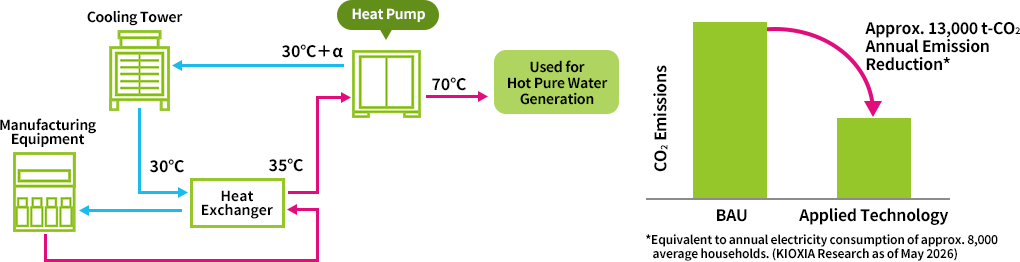
The Kioxia Group will further strengthen its commitment to net-zero following the SBTi's approval of its near-term target. Especially important one is the reduction of energy use. Energy conservation is an essential measure for reducing greenhouse gas emissions because the percentage of energy consumed by utility equipment is large in factories. For this reason, we are not only introducing state-of-the-art energy-saving equipment, but also making various improvements in our daily operations. Since its inception in 1992, the Yokkaichi plant has been making effective use of the heat energy generated in the plant. Because much of the power used in manufacturing facilities is ultimately discharged as heat, circulating water is used to cool these facilities. In the past, heat generated at this time was released into the atmosphere through a cooling tower, but since 2012, heat pumps*4 have been introduced to reuse this waste heat, and a system that recovers heat from circulating water and reuse it as hot water within the factory has been introduced. These efforts led to a reduction of approximately 13,000 t-CO2 in FY2025.
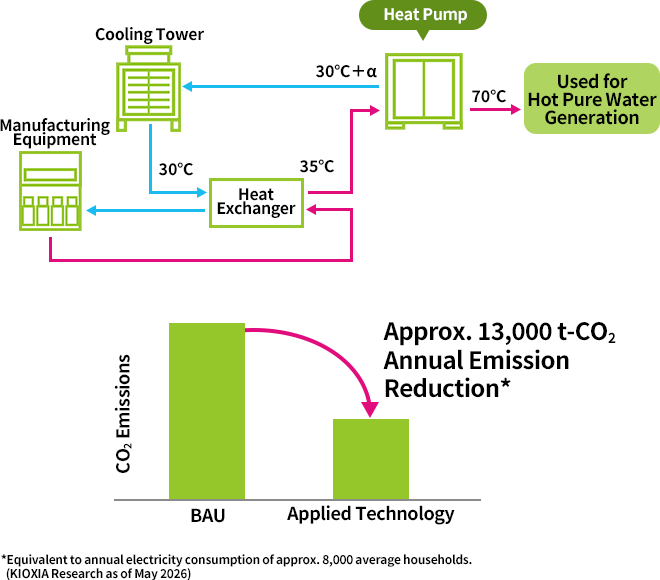
The Kioxia Group will continue to utilize renewable energy and improve equipment efficiency, realize smart factories with higher energy-use efficiency, and actively contribute to reducing greenhouse gas emissions.
- SBTi: an international initiative that promotes the setting of science based greenhouse gas emission reduction targets for companies and validates and certifies targets as a third party in order to achieve the Paris Agreement target of keeping the temperature rise from pre-industrial levels to 1.5°C
- Based on our own research
- Scope1: Direct emissions of greenhouse gases by business operators themselves (fuel combustion, industrial processes)
Scope2: Indirect emissions associated with the use of electricity, heat and steam supplied by other companies
Scope3: Indirect emissions other than Scope1 and Scope 2 (emissions by other companies related to business activities) - A device that effectively heats and cools the surroundings using air, water, etc., and realizes a high energy saving effect by transferring heat that exceeds energy consumption


