

Please select your location and preferred language where available.
Kioxia Introduces Direct Liquid Cooling Support for Enterprise SSDs
KIOXIA CM9 Series Supports Cold-Plate Cooling Option in E3.S Form Factor for AI and Other High-Performance Environments
- October 13, 2026
- Kioxia Corporation
Tokyo - Kioxia Corporation today announced the addition of direct liquid cooling (DLC) models to its KIOXIA CM9 Series enterprise SSD lineup to support cold-plate-enabled server designs. The new E3.S DLC models also support traditional air-cooled environments. KIOXIA CM9 Series drives are currently sampling to select customers*1 and will be showcased at the 2026 OCP Global Summit, taking place October 12 – 15 in San Jose, California.
As AI and other high-performance enterprise environments continue to advance, direct liquid cooling is becoming increasingly important to address growing computing power demands and associated cooling requirements. In order to fulfill the growing compute demands, increased power requirements are driving the need for innovative heat dissipation solutions. DLC infrastructure can offer significant energy savings while enabling more servers to be cooled per rack than air cooling.
Ideal for SSD Context Caching, the new KIOXIA CM9-DLC models include read-intensive (1 DWPD) and mixed-use (3 DWPD) endurance options.
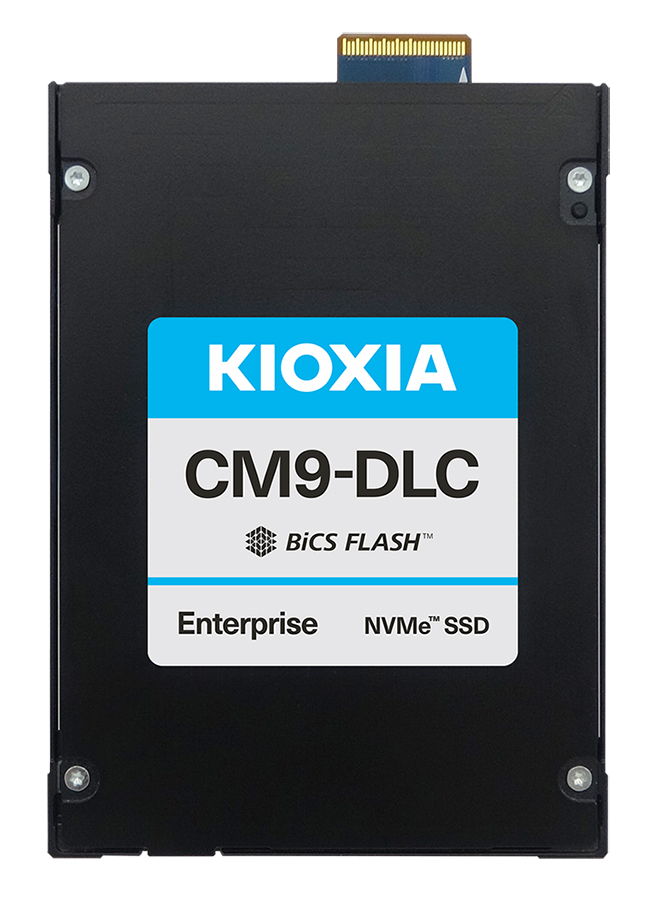
Key features of the KIOXIA CM9-DLC Series SSD include:
- PCIe® 5.0, NVMe™ 2.0, NVMe-MI™ 1.2c specification compliant
- Support for Open Compute Project (OCP) Datacenter NVMe™ SSD v2.5 specification
- Dual-port support in the E3.S SSD form factor
- Capacities up to 30.72 TB read-intensive (1 DWPD) and 25.6 TB mixed-use (3 DWPD) endurances
- Sequential performance (128 kibibytes (KiB)/QD32) of up to 14.8 GB/s read and 11 GB/s write
- Random performance (4 KiB) of up to 3,400 KIOPS (QD512) and 800 KIOPS (QD32)
Related Link:
Notes:
- These samples are for the functional check purpose only and the specifications of the samples may differ in mass production.
- Read and write speed may vary depending on various factors such as host devices, software (drivers, OS etc.), and read/write conditions.
- Definition of capacity: Kioxia Corporation defines a gigabyte (GB) as 1,000,000,000 bytes and a terabyte (TB) as 1,000,000,000,000 bytes. A computer operating system, however, reports storage capacity using powers of 2 for the definition of 1GB = 2^30 bytes = 1,073,741,824 bytes and 1TB = 2^40 bytes = 1,099,511,627,776 bytes and therefore shows less storage capacity. Available storage capacity (including examples of various media files) will vary based on file size, formatting, settings, software and operating system, and/or pre-installed software applications, or media content. Actual formatted capacity may vary.
- A kibibyte (KiB) means 2^10, or 1,024 bytes.
- DWPD: Drive Writes Per Day. One full drive write per day means the drive can be written and re-written to full capacity once a day every day under the specified workload for the specified lifetime. Actual results may vary due to system configuration, usage and other factors.
- NVMe and NVMe-MI are registered or unregistered trademarks of NVM Express, Inc. in the United States and other countries.
- OCP and OPEN COMPUTE PROJECT marks are owned by and used with the permission of the Open Compute Project Foundation.
- PCIe is registered trademark of PCI-SIG.
- Other company names, product names and service names may be trademarks of third-party companies.
Information in this document, including product prices and specifications, content of services and contact information, is correct on the date of the announcement but is subject to change without prior notice.


