

Please select your location and preferred language where available.
Kioxia Unveils Value-Oriented QLC-based KIOXIA EG7 Series SSDs for PC OEMs
New Client SSD Lineup Provides Affordable Solution for PC Applications
- April 21, 2026
- Kioxia Corporation
Tokyo – Kioxia Corporation today announced KIOXIA EG7 Series solid state drives (SSDs), the first client solution to adopt Kioxia’s BiCS FLASH™ generation 8 4-bit-per-cell, quadruple-level cell (QLC) technology. The QLC-based KIOXIA EG7 Series delivers equivalent performance as TLC-based solutions(1), enabling better total cost of ownership (TCO) for value-oriented slim laptops, as well as commercial and consumer notebooks and desktops.
KIOXIA EG7 Series SSDs bring the performance and power efficiency advantages of KIOXIA BiCS FLASH™ generation 8 QLC 3D flash memory to common computing workloads for PC OEMs. The new drives deliver random read and write performance of up to 1,000 KIOPS, sequential read speed of up to 7,000 MB/s, and sequential write speed of up to 6,200 MB/s.
The KIOXIA EG7 Series incorporates NVMe™ 2.0d support, giving PC OEMs greater flexibility in system design and device management. The drives are offered in M.2 Type 2230, Type 2242, and Type 2280 form factors, enabling broader compatibility across diverse system configurations and space constraints.
Positioned within Kioxia’s value-oriented client SSD portfolio, the DRAM-less KIOXIA EG7 Series leverages mature Host Memory Buffer (HMB) technology, utilizing a portion of system memory to help improve TCO and power consumption while maintaining responsive performance.
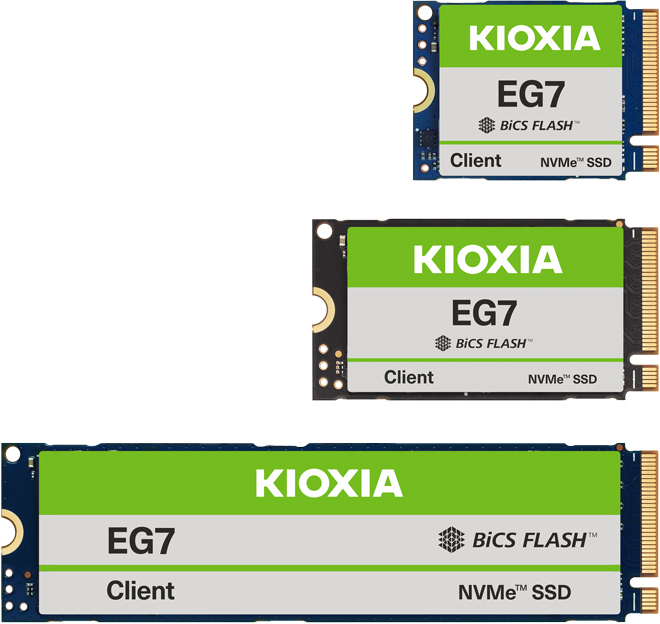
Additional features include:
- PCIe® 4.0 specification compliant
- Self-Encrypting Drive (SED) support based on TCG Opal version 2.02
- Capacities of 512 GB, 1024 GB, and 2048 GB
The KIOXIA EG7 Series is currently sampling to select PC OEM customers, with PC shipments equipped with the SSD expected to begin from the second quarter of 2026 onwards.
Notes:
- Compared to KIOXIA BG7 Series SSDs
- Definition of SSD capacity: Kioxia Corporation defines a kilobyte (KB) as 1,000 bytes, a megabyte (MB) as 1,000,000 bytes, a gigabyte (GB) as 1,000,000,000 bytes, a terabyte (TB) as 1,000,000,000,000 bytes, and a kibibyte (KiB) is 1,024 bytes. A computer operating system, however, reports storage capacity using powers of 2 for the definition of 1GB = 2^30 bytes = 1,073,741,824 bytes and 1TB = 2^40 bytes = 1,099,511,627,776 bytes and therefore shows less storage capacity. Available storage capacity (including examples of various media files) will vary based on file size, formatting, settings, software and operating system, and/or pre-installed software applications, or media content. Actual formatted capacity may vary.
- Read and write speed may vary depending on the host device, read and write conditions, and file size.
- IOPS: Input Output Per Second (or the number of I/O operations per second)
- Availability of the SED model lineup may vary by region
- NVMe is a registered or unregistered mark of NVM Express, Inc. in the United States and other countries.
- PCIe is a registered trademark of PCI-SIG.
- Other company names, product names, and service names may be trademarks of third-party companies.
Customer Inquiries:
Information in this document, including product prices and specifications, content of services and contact information, is correct on the date of the announcement but is subject to change without prior notice.


